 The Value of Woody Debris in our Rivers
The Alouette River Management Society works with many partners to replace some of the woody debris that has been lost over the last century.
One of the most critical components of salmonid habitat is cover, particularly for rearing juveniles. Rearing fish tend to occupy covered habitats for extended periods of time. They rarely leave these areas except for short foraging and feeding excursions into more exposed stream habitats.
Loss of Woody Debris contributes to the reduction of fish populations.
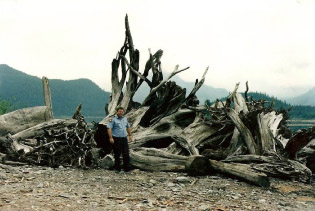 Salmonid streams should contain a diversity of cover types. Submerged cover such as large woody debris, boulders, rubble and aquatic vegetation afford protection from predators, while overhead cover such as floating debris, undercut banks, turbulence and overhanging vegetation provide shade as well as protection from predators.
Root wads, trash bundles and trees can be secured at key locations within a stream to increase the amount of submerged and overhead cover for rearing fish. Cedar is the preferred species, but other species are acceptable due to their high resin content. Fast rotting species such as alder or cottonwood are avoided.
Stumps remnant from valleys flooded for hydroelectric dams are often used on LWD Projects
 Trees and root wads are anchored in a manner that avoids damming the flow. Trees are placed with the branches trailing downstream with the butt section steel cabled and anchored to engineered standards along the streambank.
Loose root wads can also be placed in protected pools, like those behind beaver dams, where there isn’t any danger of them washing downstream.
During 1997 to 1998 a total of 48 instream large woody debris structures were placed in the Alouette River from Allco Park to the Alouette Reservoir Dam. An additional 7 structures were installed in the lower Alouette as well by a private property owner. This work has developed 3,440 square meters of large woody debris covered habitat that was not previously available to juvenile fish.
An assessment of these structures later showed that both coho and steelhead parr were using this new habitat. In fact, coho were nine times more abundant under the woody debris than in untreated open areas of the river. Steelhead were twice as abundant.
 In 2005, the Georgia Basin Steelhead Recovery Program was funded through BC Hydro’s Bridge Coastal Fish and Wildlife Restoration Program to assess the habitat and write prescriptions for the installation of large woody debris within the “Corrections” reach of the Alouette River. A copy of this assessment can be found at www.bchydro.com//projects/docs/bridge_river/05.Al.01.pdf.
The Georgia Basin Steelhead Recovery Program was successful in their 2006 application to and the instream work was completed during the summer and fall of 2006. ARMS provided assistance to this team to ensure its success. A link to this report will be provided when the completed.
In 2006, Shaun Korman, Katharine Scotton and Dave Taylor, three BCIT Fish and Wildlife students, conducted further studies to determine the effect of the 1997 and 1998 LWD placement in the upper reaches of the Alouette River. While not conclusive, it would appear through this study that these “aquatic condos” are being well utilized in our river.
A graph of the winter LWD Habitat is below.
Winter Habitat Usage – Comparison of Species
 For a review of the power point presentation by Korman, Taylor and Stotten NOTHING PROVIDED
